Learn More

 
Skip to main content
Koch Agronomic Services Logo
SolutionsKnowledge CenterAboutRetailers & Reps
Labels / SDS
Contact
Labels / SDS
Contact
US
USCAINT
Map of the World

Find a Rep or Retailer

With our network of knowledgeable representatives, retailers and distributors, you can be confident you will get the best solution for your unique needs. Find your nearest Koch Agronomic Services, LLC, representative.

 
Contact Us
Find a Rep or Retailer

Connect with Koch Agronomic Services

Facebook IconLinkdein IconTwitter IconYouTube Icon
Koch logo

Solutions

AGROTAIN™PHOSFORCE™WOLF TRAX™PROTIVATE™ANVOL™OPTRIENT™CENTURO™SUPERU™
Knowledge CenterPodcastsResearch & ReportsArticlesProduct Labels/SDSs
AboutPress ReleasesCareers
Retailers & RepsFind a Rep or Retailerpage links
US
USCAINT
Koch Logo

Privacy Policy · Do Not Sell or Share My Personal Information · California Supply Chain Transparency · Modern Slavery Statement · Terms of Use · Patent Information

AGROTAIN™, the AGROTAIN logo, ANVOL™, the ANVOL logo, CENTURO™, the CENTURO logo, ARMOUR™, the ARMOUR logo, OPTRIENT™, the OPTRIENT logo, N-TEGRATION™, the N-TEGRATION logo, SUPERU™, and the SUPERU logo, TRIBUNE™, the TRIBUNE logo, SYNTHOS™, the SYNTHOS logo, NUTRICARE™, the NUTRICARE logo, WOLF TRAX™, the WOLF TRAX logo, PROTIVATE™, the PROTIVATE logo, 3-TRAX™, DDP™, CROP MIX™, NU-TRAX™ and EVENCOAT™ are trademarks of Koch Agronomic Services, LLC. Koch, the Koch logo and Principle Based Management™ are trademarks of Koch IP Holdings, LLC. © 2026 Koch Agronomic Services, LLC. All Rights Reserved.

1. EPA EEF Challenge Submission data: 30% reduction - corn (Chatterjee et al, 2016); 34% reduction - corn (Chatterjee et al, 2016); 45% reduction - corn (Yang et al, 2016); 35% reduction - corn (Eagle et al, 2017); 48% reduction - irrigated no-till corn (Halvorson et al, 2010); 53% reduction - semi-arid irrigated corn (Dugan et al, 2017); 43.8% reduction - sandy loam soil (Awale and Chatterjee, 2017).

The data and material contained herein are provided for informational purposes only. No warranty, express or implied, is made including, but not limited to, implied warranties of merchantability and fitness for a particular purpose, which are specifically excluded. Results may vary based on a number of factors, including environmental conditions. Before use, consult the product packaging and labeling for information regarding the product's characteristics, uses, safety, efficacy, hazards and health effects.

Not all products may be available in your jurisdiction.

CENTURO is not registered for sale or use in all jurisdictions. In the United States, contact your state pesticide regulatory agency to determine if a product is registered for sale or use in your state. Results may vary based on a number of factors, including environmental conditions. Improvements in nutrient use efficiency, yield and nitrate leaching may not be observed in all cases.

PROTIVATE NU5-LUX is not available for sale, use or distribution in California.
image
 

Latest Resources

Two growersArticleThe truth about UAN loss: Why stabilization matters more than you thinkPlanter box seed treatementArticleAgronomy Q&A: Understanding PROTIVATE™ and Its Role in Crop SuccessNutrientsArticleFueling the Foundation for Early Crop GrowthcornArticleGrower and Retailer Perspectives on Early Crop Success with PROTIVATE™ Corn side-by-side timelaspeArticleSee the PROTIVATE™ Advantage in Action

December 11, 2025

Are You Losing Cotton Yields to Plant Stress?

For cotton growers, the entire season is a unique challenge. You are managing a perennial plant as an annual, forcing it to balance vegetative growth and reproduction simultaneously. This delicate balance puts an enormous strain on the plant, especially during peak flowering and boll development.

“The main goal of a cotton plant is to set as many bolls as it can and then hold on to them,” said Matt Fryer, technical agronomist for Koch Agronomic Services (KAS).

During this high-demand period, the plant’s nutrient needs can exceed the root system’s ability to keep up. This nutrient deficit causes the plant to experience stress, and a stressed cotton plant will protect itself.

“When that plant gets under heat or drought stress, it’s going to start shedding its fruit,” Fryer explained. “A perennial plant’s goal is to survive, not produce fruit.”

This shedding of squares and bolls is a direct hit to a grower’s bottom line. The key to preventing this loss and protecting yield is to mitigate plant stress during these critical growth stages. This is where a targeted foliar nutrient application can make a significant difference.

The role of nitrogen use efficiency

One way to limit plant-damaging stress is to improve the plant’s nitrogen use efficiency. A cotton plant has to expend a large amount of energy to convert nitrogen into amino acids and other organic compounds used for various plant functions. If this process is inefficient, it acts as a constant drain on the plant’s resources, making the plant more susceptible to environmental stressors.

“We're not trying to replace a soil-applied nitrogen program,” stated Fryer. “We’re just trying to make the nitrogen that’s already in the plant more efficient. When the cotton plant is not under stress, it's going to set more bolls and hold on to them longer.”

OPTRIENT™ MoCo-Ni is a foliar nutrient from KAS designed to do precisely that.

“What makes OPTRIENT MoCo-Ni such a great product for cotton is its specific blend of molybdenum, cobalt and nickel, because all three play a significant role in nitrogen metabolism,” Fryer explained. “Molybdenum is key for converting nitrates into proteins and amino acids, while cobalt helps mitigate plant stress hormone production. Nickel is essential for the urease enzyme, which helps the plant metabolize urea. It’s about making the entire nitrogen process, from initial uptake to internal processing, more efficient.”

Proven cotton lint yield gains   

The agronomic theory is one thing, but the real test is in the field. Recent trial data1 from the Cotton Belt highlights the value of this approach, showing a clear, positive impact on lint yield:

  • In a North Carolina study, a split application increased cotton lint yield by 107 lbs/acre.
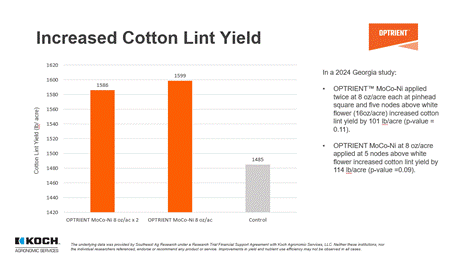
  • In a Georgia study, a split application increased cotton lint yield by 101 lbs/acre.
  • That same Georgia study also showed a single application at five nodes above white flower increased cotton lint yield by 114 lbs/acre.


Operational flexibility and ease of use

Another advantage of OPTRIENT MoCo-Ni is its seamless integration with a grower’s existing program. 

“What’s really encouraging from the trials is that we saw this benefit across varied application timings,” said Fryer. “This tells us the application window is pretty wide and flexible. For a grower already making multiple passes for crop protection, this flexibility is a huge operational advantage. It provides plenty of opportunities to add it to a tank mix they're already planning.”

That operational ease is a core part of the product’s design.

“From an operational standpoint, that flexibility is key,” Fryer stated. “OPTRIENT MoCo-Ni is a very clean, chelated liquid that's easy to handle. The compatibility is excellent, so it rides really well with anything and won’t clog strainers or tips. That ease of use is a big, big plus for the grower.”

Healthier plants, higher lint yield

A healthier, less-stressed cotton plant is more productive. By improving nitrogen efficiency at key timings, OPTRIENT MoCo-Ni supports cotton’s ability to hold onto its fruiting positions and develop those bolls to their full, harvestable potential, translating directly into a higher lint yield for the grower. This success in cotton is just one example of how this technology performs in row crops. 

1The underlying data was provided by Fowler Crop Consulting under a Research Trial Financial Support Agreement with Koch Agronomic Services, LLC. Neither these institutions, nor the individual researchers referenced, endorse or recommend any product or service. Improvements in yield and nutrient use efficiency may not be observed in all cases


Resource Categories
CottonArticleSoybeansSpecialty CropOPTRIENT